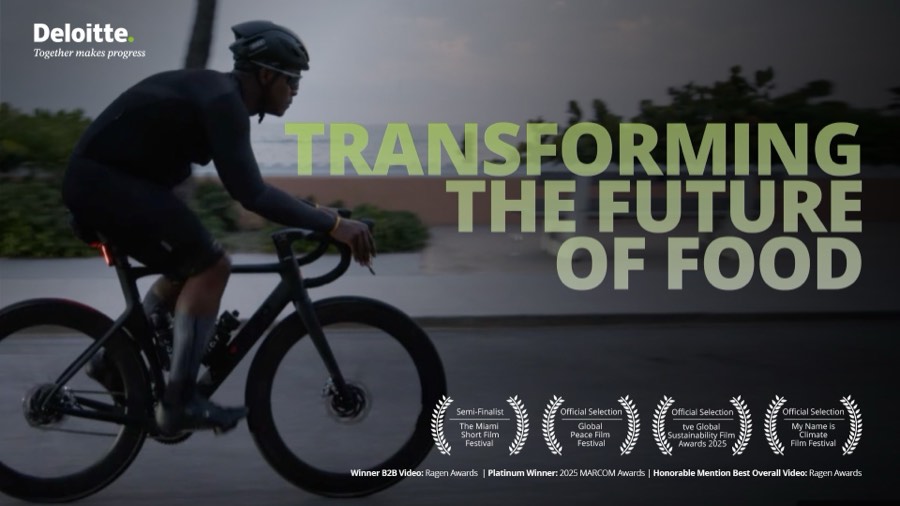
For the last two years I've directed and executive produced Horizons, a documentary series that tells real stories about companies rebuilding themselves under new pressure: new technology, new markets, new expectations. Two films are out so far, Hydrogen Hubs and Transforming the Future of Food, with Making the Invisible Visible and more still in the works. Running a series like this inside a company the size of Deloitte taught me things no film set or agency job had.
Serve the story before the business case
Every one of these films starts with a real business reason to exist: a market worth being known in, a relationship worth deepening, proof that the firm can do more than advise. I don't pretend otherwise. But the moment a film starts explaining itself instead of showing something true, an audience feels it immediately and stops watching. The versions that have actually worked are the ones where I forgot about the business case entirely while we were shooting, and trusted a genuinely good story to do that work on its own, later, without help.
Getting in the room takes longer than making the film
On an independent documentary, access is mostly persistence and a good pitch. Inside a large company, access runs through account teams, client relationships, and whoever already owns the trust of the person you want on camera. Some of the best subjects I've worked with took months of relationship-building before a single frame got shot. I used to think of that as overhead standing between me and the film. I don't anymore. Doing it well is often what makes someone trust you enough to say something true once the camera is finally rolling.
A film has more editors before it's a film than after
Every cut goes through more eyes inside a corporation than it would almost anywhere else: brand, legal, the client relationship team, communications. Left unmanaged, that process sands a film down until it says nothing. My job became less about protecting every individual choice and more about protecting the one or two moments in each film that had to survive every round of notes untouched, the actual human beat the whole thing was built around. Everything else, I learned to hold loosely.
A series needs one throughline, even when the director changes
I don't direct every film in the series myself. Some I executive produce and hand to other directors, trusting their eye completely on their own film. What ties a series together isn't one director's style, it's a consistent question underneath every episode: what does it actually take to change how a business works, told through the person doing it. Holding onto that question, more than any visual signature, is what makes several different films feel like one series.
None of this is written down anywhere at the company. I mostly learned it by getting it wrong the first few times. If you're trying to make honest work inside a place that also needs that work to do something for the business, that tension doesn't resolve. You just get better at holding both at once.